
Beschreibung
Lemon tetra (Hyphessobrycon pulchripinnis) – bright yellow schooling fish for lively aquariums
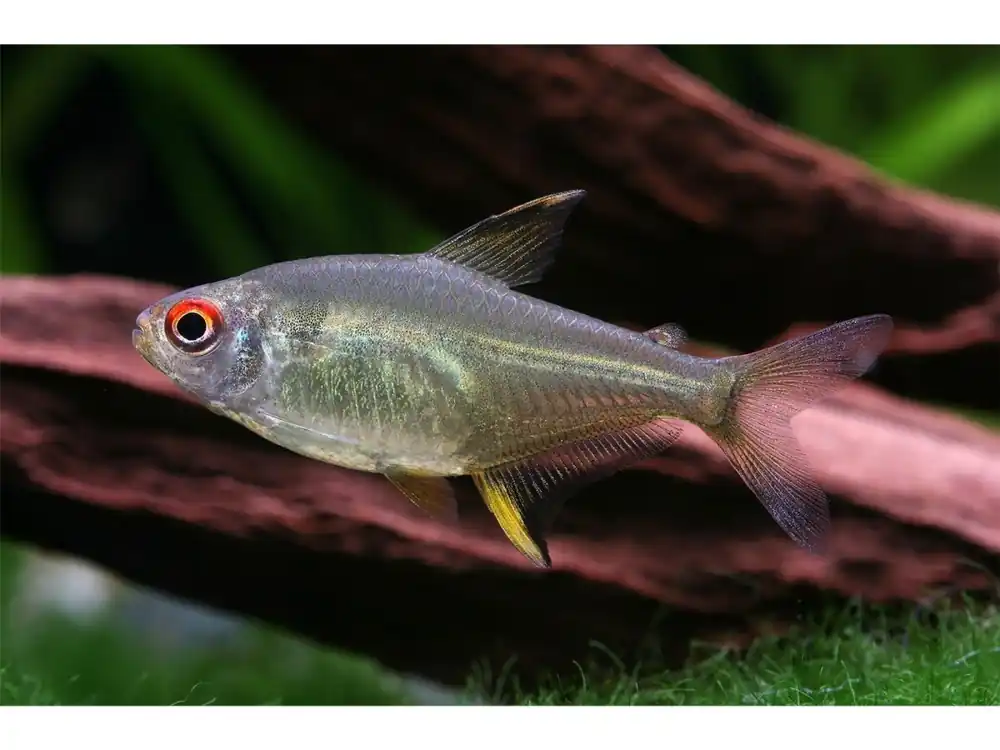
The lemon tetra, also known as the lemon tetra or yellow tetra, is an attractive and robust schooling fish from South America. Its lemon yellow basic coloration with contrasting black fin edges makes it an eye-catching yet harmonious addition to classic community aquariums.
Description & behavior
Hyphessobrycon pulchripinnis reaches a final size of around 4-5 cm. The body is light yellow to lemon-colored, intensely bright when kept optimally. Characteristic are the black fringing on the dorsal and anal fins and the reddish shimmering eyes.
The lemon tetra is an active but peaceful schooling fish. A group of at least 8-12 animals is recommended. In larger groups, intra-species imposing behavior is clearly distributed and the natural swarming pattern is better accentuated.
Keeping & setup
An aquarium of 80-100 liters or more with dense marginal planting and free swimming space is ideal. Dark substrate visibly enhances the yellow coloration. Roots and plants provide places to retreat to without restricting the swimming space.
A light to medium current is well tolerated. Regular water changes support vitality and color intensity.
Water values
The lemon tetra is considered to be relatively adaptable and preferred:
- Temperature: 22-28 °C
- pH value: 6.0-7.5
- Total hardness: 5-15 °dGH
- Carbonate hardness: up to approx. 8 °dKH
- Conductance: up to approx. 600 µS
Stable water values are more important than exact compliance with individual limit values.
Nutrition
Hyphessobrycon pulchripinnis is an uncomplicated omnivore. Suitable foods are:
- Flake and granulated food
- Frozen food (Artemia, mosquito larvae)
- Live food
A varied diet promotes intense colors and readiness to spawn.
Socialization
The lemon tetra is peaceful, but may be prone to slight fin nipping if the group size is too small.
- With shrimps: Possible with larger dwarf shrimps. Young shrimps are eaten.
- With crabs & crayfish: Not recommended. There is a risk of injury and stress on both sides.
- With snails: No problem.
- With fish: Well suited with other robust tetras, danios, dwarf cichlids and armored catfish. Not ideal with very long-finned or extremely calm species.
Reproduction & breeding
The lemon tetra is a free spawner without brood care. Eggs are laid between fine plants or on spawning substrate. A separate breeding tank with slightly softer water is recommended for targeted breeding.
After spawning, the parents should be removed as they will chase after the spawn. The fry are initially fed with infusoria and later with Artemia nauplii.
Special features
Due to its striking yellow coloration, Hyphessobrycon pulchripinnis forms a nice contrast to blue- or red-coloured tetras. It is considered a robust starter fish for larger community aquariums.
Profile:
| Name | Hyphessobrycon pulchripinnis |
| German name | Lemon tetra |
| Other trade names | Lemon Tetra, Yellow Tetra |
| Family | Characidae (true tetras) |
| Origin | South America (Brazil) |
| Final size | approx. 4-5 cm |
| Life expectancy | approx. 4-6 years |
| Social behavior | Peaceful, active schooling fish |
Requirements & water values:
| Aquarium size | from 80-100 liters |
| Temperature | 22-28 °C |
| pH value | 6,0-7,5 |
| Total hardness (GH) | 5-15 °dGH |
| Carbonate hardness (KH) | up to approx. 8 °dKH |
| Conductance | up to approx. 600 µS |